Winzo

Made in India app. Click the link to download https://winzo.onelink.me/gu8K/extphbyn
Showing posts with label thermodynamics. Show all posts

Thursday, March 25, 2021

properties of pure substances

Properties of Pure Substance

  • A pure substance is a material with homogeneous and invariable composition.
  • Pure substances can have multiple phases, an ice water mixture is still a pure substance but an air-steam is not a pure substance.

Pure Substance:

  • A substance that has a fixed chemical composition throughout is called a pure substance i.e., water, nitrogen, helium, and CO2.
  • Substances which are mixture of various elements or compounds also qualifies as pure substances as long as mixture is homogeneous.

Saturation Temperature and Saturation Pressure:

  • At given pressure, the temperature at which a pure substance changes phase is called the saturation temperature Tsat.
  • Likewise at a given temperature, the pressure at which a pure substance changes phase is called the saturation pressure psat.

Example: For water at a pressure of 101.325 kPa, Tsat is 100oC, conversely at a temperature of 100oC, psat is 101.325 kPa.

Latent Heat:

  • The amount of energy absorbed or released during a phase change process is called the latent heat.
  • The amount of energy absorbed during melting is called the latent heat of vaporization.
  • Similarly, the amount of energy absorbed during vaporization is called latent heat of vaporization and is equivalent to the energy released during condensation.

Liquid-Vapour Saturation Curve:

From the following figure, it is clear that Tsat increases with psat. Thus, a substance at higher pressure will boil at higher temperatures.

Tsat = f(psat)

  • In the kitchen, higher boiling temperature means shorter cooking time and energy saving.
  • The atmospheric pressure, and thus the boiling temperature of water, decreases with elevation. Therefore, it takes longer time to cook at higher altitudes than it does at sea level.

Property Diagrams for Phase-change Process

The T-V Diagram:

  • Consider piston cylinder device containing liquid water at 20oC and 1 atm.
  • Water will start boiling at a much higher temperature (179.9oC) at inside pressure of the cylinder reaches at 1 MP.
  • The specific volume of the saturated liquid is larger and the specific volume of the saturated vapour is smaller than the corresponding values at 1 atm pressure. That is, the horizontal line that connects the saturated liquid and saturated vapour states is much shorter.
  • As the pressure is increased further, this saturation line will continue to get shorter as shown in figure and it will become a point when the pressure reaches 22.09 MPa for the case of water. This point is called the critical point and it is defined as the point at which the saturated liquid and saturated vapour state are identical.
  • At pressure above the critical pressure, there will not be a distinct phase change. Instead, the specific volume of the substance will continually increase and at all times there will be only one phase present. It is customary to refer to the substance as superheated vapour at temperature above the critical temperature and as compressed liquid at temperatures below the critical temperature.

The p-V Diagram:

  • The general shape of the p-V diagram of a pure substance is very much like the T-V diagram but the T = constant lines on this diagram have a downward trend.
  • Consider again a piston cylinder device that contains liquid water at 1 MPa and 150°C, water at this state exists as a compressed liquid. Now, the weights on top of the piston are removed one by one so that the pressure inside the cylinder decreases gradually.
  • The water is allowed to exchange heat with the surroundings so its temperature remains constant.
  • As the pressure decreases, the volume of the water will increase slightly, when the pressure reaches the saturation pressure volume at the specific temperature, the water will start to boil.
  • During this vaporisation process, both the temperature and the pressure remain constant but the specific volume increases. Once the last drop of liquid is vaporised further reduction in pressure results in a further increase in specific volume. 
  • If the process is repeated for other temperatures similar paths will be obtained for the phase change processes.

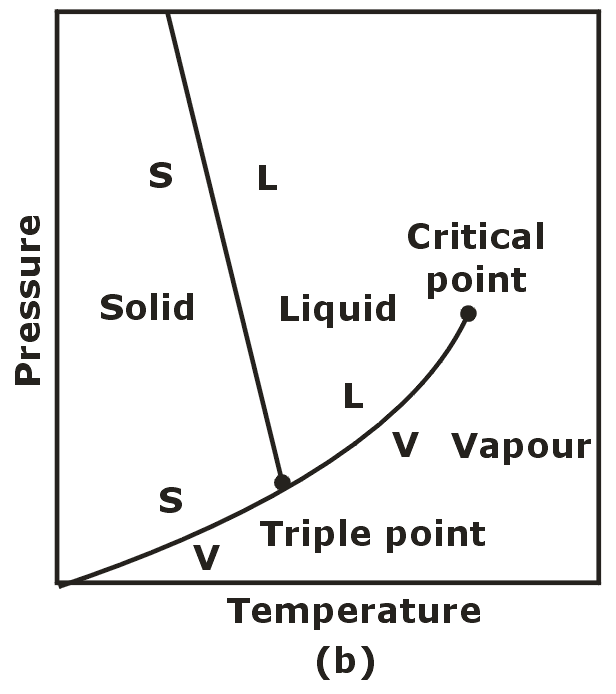
Triple Phase:

  • When all three phases of a pure substance co-exist in equilibrium. It is called triple phase.
  • Triple phase states form a line called the triple line.
  • The triple line appears as a point on the p-T diagram and therefore is often called the triple point.

  • No substance can exist in the liquid phase in stable equilibrium at pressure below the triple point pressure.
  • The same can be said for temperature for substance that contract on freezing.
  • Substances at high pressure can exist in the liquid phase at temperatures below the triple point temperature.

The p-T Diagram:

  • Solid – Liquid = Fusion
  • Liquid – Vapour = Vaporisation
  • Solid – Vapour = Sublimation

Enthalpy

  • Enthalpy is a measure of the total energy of a thermodynamic system.
  • It includes energy required to create a system and the amount of energy required to make room for it by displacing its environment and establishing its volume and pressure.
  • For certain type of processes particularly in power generation and refrigeration.
    • Enthalpy (H )= U + pV(kJ) Or
    • per unit mass h = u + pV(kJ/kg)

Saturated Liquid and Saturated Vapour States:

  • Subscript f → properties of saturated liquid
  • Subscript g → properties of saturated vapour
  • Vf → specific volume of saturated liquid
  • Vg → specific volume of saturated vapour
  • Vfg → difference between Vg and Vfnthal
  • Vfg = Vg - Vf
  • hfg → enthalpy of vaporisation or latent heat of vaporisation (amount of energy need to vaporise a unit mass of saturated liquid at a given temperature of pressure).
  • The magnitude of latent heat depends on temperature and pressure at which phase change occurs.
  • For example at 1 atm pressure, the latent heat of fusion of water is 333.7 kj/kg and latent heat of vaporization is 2257.1 kj/kg. 
  • At below triple point pressure, substance begins to change directly gas.
  • Enthalpy of vaporization decreases as the temperature or pressure increases and become zero at the critical point.

Saturated Liquid Vapour Mixture:

  • During vaporisation process, a substance exists as part liquid and part vapour.
  • A new property quality x is the ratio of mass of vapour to the total mass of the mixture.

Quality or dryness fraction:

mtotal = mliquid + mvapour = mf + mg

where, mf = mass of the saturated liquid, and mg = mass of the saturated vapour

  • Quality has significance for saturated mixtures only.
  • It has no meaning in the compressed liquid or superheated region.
  • Its value lie between 0 (saturated liquid) and 1 (saturated vapour).
  • The properties of the saturated liquid are the same whether it exists alone or in a mixture with saturated vapour.
  • During vaporization process, only the amount of saturated liquid changes not its properties. The same can be said about a saturated vapour.

Quality :

  • Vav = (1-x)Vf + xVg or Vav = Vf + xVg
  • Uav = Uf + Ufg
  •  hav = hf + xhfg

Superheated Vapour :

Since, the superheated region is a single phase region (vapour phase only) temperature and pressure are no longer dependent properties and they can conveniently be used as the two independent properties.

Superheated vapour is characterised by: 

  • Lower pressures (p < psat at a given T)
  • Higher temperatures (T < Tsat at a given p)
  • Higher specific volumes (U > Vg at a given p or T)
  • Higher internal energies (U > Ug at a given p or T)
  • Higher enthalpies (h > hg at a given p or T)

Compressed Liquid

  • A compressed liquid may be approximated as a saturated liquid at the given temperature.
  • This is because the compressed liquid properties depend on temperature much more strongly than they do on the pressure.
    • ≅ Vf
    • u ≅ uf
    • h ≅ hf
  • In general, a compressed liquid is characterised by:
    • Higher pressures (p > psat at a given T)
    • Lower temperatures (T < Tsat at a given p)
    • Lower specific volumes (V <Vf at a given p or T)
    • Lower internal energies (U < Uf at a given p or T)
    • Lower enthalpies (h < hf at a given p or T)

The Ideal Gas Equation of State

  • Any equation that relates the pressure, temperature and specific volume of a substance is called an equation of state.
  • Property relations that involve other properties of a substance at equilibrium states are also referred to as equation of state.
  • Ideal gas equation of state: pV = RT, where, p = Absolute pressure, T = Absolute temperature, and V = Specific volume
  • Gas and vapour are often used as synonymous words.
  • The vapour phase of a substance is customarily called a gas when it is above the critical temperature.
  • Vapour usually implies a gas that is not far from a state of condensation.

Gas Constant

  • It has been experimentally observed that the ideal gas relation given closely approximately the p-V-T behaviour of real gases at low densities.
  • At low pressure and high temperature, the density of a gas decreases and the gas behaves as an ideal gas under these conditions.

where, Ru = Universal gas constant, M = Molar mass, R = Gas constant.

Compressibility Factor

  • Compressibility factor (correction factor) is measurement of deviation of gases from ideal gas behaviour.
  • Compressibility factor (z):

  • It can also be expressed as

  • For ideal gases ⇒ z = 1
  • For real gases ⇒ z is away from unity (> 1 or < 1)

Reduce Pressure and Temperature

  • Gases behave differently at a given temperature and pressure, but they behave very much the same at temperature and pressures normalized with respect to their critical temperatures and pressures.
  • The normalization is done as introducing new terms,
    • Reduce pressure:


and reduce temperature:


where, Tcr = critical temperature, pcr = critical pressure.

z factor for all gases is approximately the same at the same reduced pressure and temperature is greatest in the vicinity of the critical point.

  • Gases deviate from the ideal gas behaviour most in the neighborhood of the critical point. So, we can say that at critical point. Compressibility factor is constant for all substances.
  • As mention above z factor for all gases is approximately the same at the same reduced pressure and temperature. 
  • Pseudo reduced specific volume (VR) :

  • VR is defined differently from pR and TR. It is related to Tcr and pcr instead of Vcr.
  • All substances have same critical compressibility factor

  •  Experimental value of Zc for most substances fall within a narrow range of 0.20 – 0.33.
  • Z the compressibility factor is the same function of pr and Tr for all gases.
  • Specific heat all constant pressure and volume are the properties of the substances and are always properties.


Van der wall’s Equation of State:

  • Two effects: Inter molecular attraction forces:

 and b accounts for volume occupied by the gas molecules.

Virial Equation of State:

Van der Waal’s equation of state can be expressed in the virial form as given below

This is called the virital equation of state.


energy availability and irreversibility

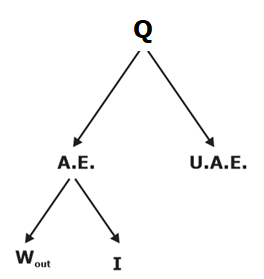
The sources of energy can be divided into two groups i.e., high grade energy (mechanical work, electrical energy, water power, wind power) and low grade energy (heat or thermal energy, heat derived from nuclear fission or combustion of fossil fuels). That part of the low grade energy which is available for, conversion is referred to as available energy, while the part which is not available is known as unavailable energy.

Availability: When a system is subjected to a process from its original state to dead state the maximum amount of useful work that can be achieved under ideal conditions is known as available energy or availability of the system.

Wmax = AE = Qxy – T0(Sy-Sx)

Unavailable Energy:  UAE = T0(Sy-Sx)

where, Sx and Sy are the entropy at x and y, respectively.

The Available Energy (AE) is also known as exergy and the Unavailable Energy (UAE) as anergy. The energy which cannot be utilised for doing useful work is called unavailable energy. Irreversibility is equivalent to energy destroyed, hence also known as energy destruction consider the example given below.

DECREASE IN AVAILABILITY WHEN HEAT TRANSFER THROUGH FINITE TEMPERATURE DIFFERENCE

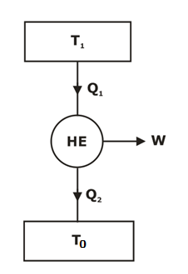
Consider a reversible heat engine operating between Tand T0.

Q1 = T1. Δs

W = AE= (T1 – T0)Δs

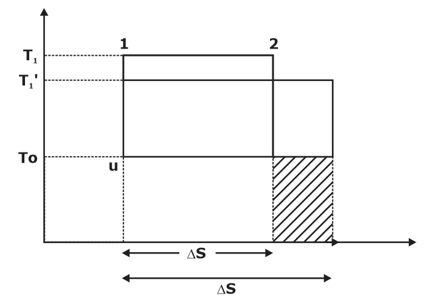
Let us now consider heat Q1 is transferred through a finite temperature difference.

Q1 = T1 Δs = T’1 . Δs’

Δs’ > Δs

Q2 = T0 Δs → Initial UAE

Q’2 = T0 Δs’ ⇒ Afterward UAE

Q’2 > Q2

W’ =Q’1 – Q’2

W’ = T’1 Δs’ – T0Δs’

W’ = (T’1 – T0) Δs’

W = (T1 – T0) Δs

Hence increase in UAE and the shaded portion represent increase in UAE.

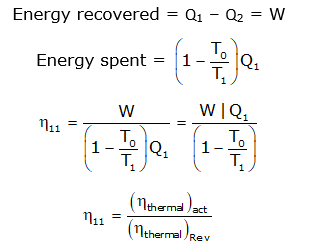
SECOND LAW EFFICIENCY: Second law efficiency is the ratio of the exergy recovered to the exergy spent. OR It is the ratio of actual work produced to the max work produced under reversible condition. Consider the case of heat engine.

The second law efficiency is measure of the performance of a device relative to its performance under reversible conditions.

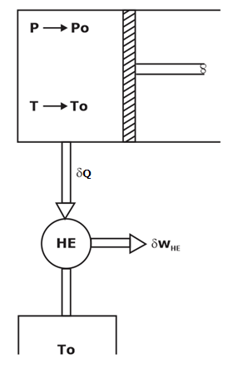
EXERGY OF A CLOSED SYSTEM : Consider a piston cylinder device that contains a fluid of mass m at temperature T and pressure P. The system is then allowed to undergo a differential change of state during which volume changes by dV and heat  is transferred from the system to surroundings.

For change of exergy from state 1 to state 2.

Φ1 = (E1 – E0) + P0(V1 – V0) – T0(S1 – S0)

Φ2 = (E2 – E0) + P0(V2 – V0) – T0(S2 – S0)

Φ1 – ϕ2 = Energy at state 1 – Energy at state 2

Φ1 – ϕ= (E1 – E2) + P0 (V1 – V2) – T0(S1 – S2)

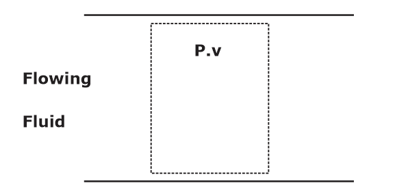
EXERGY OF OPEN SYSTEM: A flowing fluid has an additional form of energy, called flow energy, which is the energy needed to maintain flow in Pipe.

Wflow = PV

Exergy associated with system is 

Φflowing fluid = ϕnon flow fluid + ϕflow

Φflowing fluid = (E1 – E0) + P0(V1 – V0) – T0(S1 – S0) +P1V1 – P0V0

Φflowing= U1- U0 + (KE)1 - (KE)0 + (PE)1 – (PE)0 + P1V1 – P0V0 – T0 (S1 – S0)

Φflowing fluid = (U1 + P1V1) – (U0 + P0V0) – T0(S1 – S0) + (KE)1 – (KE)0 + (PE)1 – (PE)0

Φflowing = (H1 – H0) – T0 (S1 – S0) + (KE)1 – (KE)0 + (PE)1 – (PE)2


generation & change in entropy

Entropy

The Clausius Inequality

  • The first law is just a balance of energy.
  • The second law states an inequality ie an irreversible process is less efficient than a reversible process.
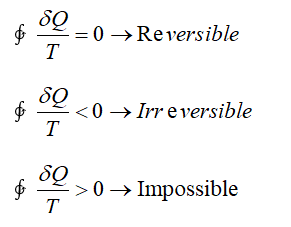
  • One of such important inequalities is that of the Clausius inequality in Thermodynamics according to which the cyclic integral of δQ / T is always less than or equal to zero.
  • It is valid for all cycles, be it reversible or irreversible.
  • The basis for the definition of a new property called entropy is formed by the Clausius inequality.
  • For an internally reversible process, the cyclic integral of δQ / T is zero.
  • If the cyclic integral of a quantity is zero, it means that it depends on the state only and not the process path. Hence, it is a property.
  • For an irreversible process, the value of entropy change for a closed system is greater than the value of integral of dQ/T evaluated for that process.
  • If the energy exchange takes place, δQ will be the energy transfer from the surroundings to the system.


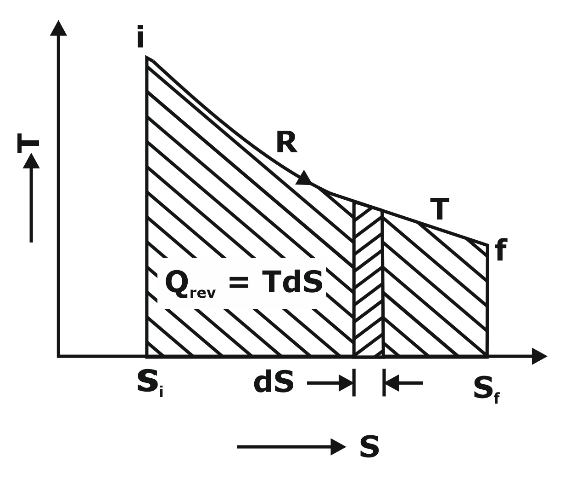
TEMPERATURE-ENTROPY PLOT

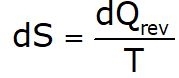
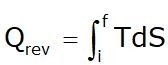
Now dQrev, = TdS

Thus, area under the T -S plot on S axis will give the heat transfer in a reversible process.

Fig.: Area under a reversible path on the T-s plot

CARNOT CYCLE

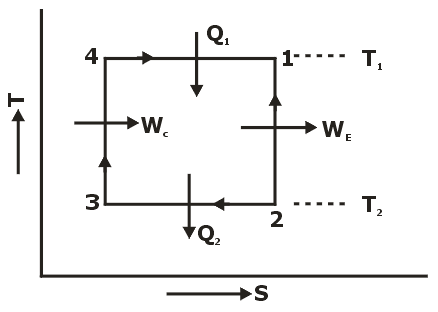
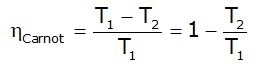
The Carnot cycle comprises of two reversible isotherms and two reversible adiabatic processes, forms a rectangle in the T-S plane.

process 1 – 2: The reversible adiabatic expansion of the system developing WE amount of work.

process 2 – 3: The reversible isothermal heat rejection from the system to the external sink at temperature T2.

process 3 – 4: The reversible adiabatic compression of the system absorbing Wc amount of work.

Process 4 – 1: The reversible isothermal heat addition Q1 to the system at temperature T1 from an external source.

THE INCREASE OF ENTROPY PRINCIPLE:

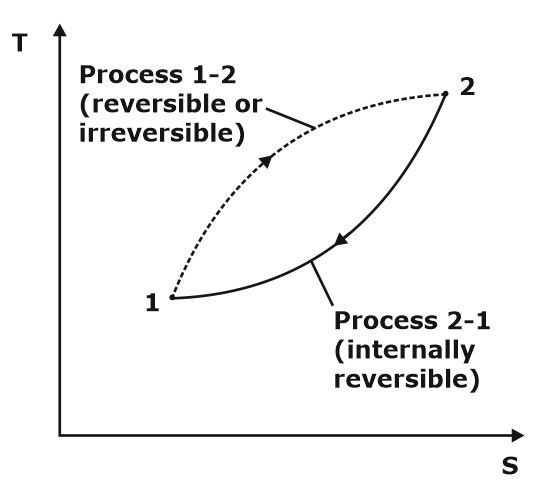
Let us assume a cycle that is made up of two processes as shown below:

process 1-2, which is an arbitrary process (reversible or irreversible),

and process 2-1, which is internally reversible in nature, as shown in the Figure below,

Fig.: Combination of reversible & irreversible process

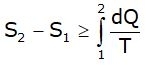
where the equality is for the internally reversible process and the inequality for the irreversible process.

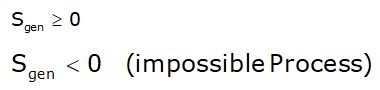
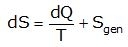
It should be kept in mind that the entropy generation Sgen is always a positive quantity or zero. Its value is process dependent, and thus it is not a property of the system.

For an isolated system, 

dQ = 0 since no energy interaction occurs between the system and the surrounding.

Therefore, for an isolated system

dSiso ≥ 0

For a reversible process,

 dSiso = 0

implies,  S = constant

 For an irreversible process

dSiso > 0

Entropy change of the system:

Entropy charge of the system is summation entropy change due to internal irreversibility and entropy change due to external interaction

dS = (dS)Irr, + (dS)EI


 T-dS EQUATION

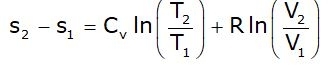
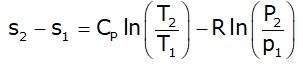
........(1)

........(2)

Note:

Equation (1) & (2) are applicable for both reversible process as well as the irreversible process because it contents all properties.

APPLICATIONS OF ENTROPY PRINCIPLE:

For every irreversible process, there is an increase of entropy of the universe, and this entropy increase determines the extent of irreversibility of the process. The higher the entropy increase of the universe; the higher will be the irreversibility of the process.

Some of the applications of the entropy principle are illustrated in the following.

(A) Heat transfer through a Finite Temperature Difference.

(B) Two fluids mixing with each other.

(C) Maximum Work that can be obtained from Two Finite Bodies at Temperatures T1 and T2 interacting in a reversible manner.


work &heat

Energy in a thermodynamic System can be transferred in three ways namely Work, Heat and by mass. A closed System and its Surroundings can interact by work transfer and Heat transfer, whereas open system can interact by work, Heat and mass transfer (because mass also carries energy).

WORK TRANSFER
Work can be defined as force multiplied by distance moved by object in the direction of applied load; we call it as mechanical work.

“Work is said to be done by a system if the sole effect on things external to the system can be used to raising of a weight”.

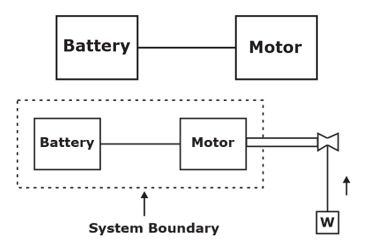
Consider the Battery and motor as system. The motor is driving a fan. When the fan is replaced by pulley and weight, the weight can be raised by distance x. Thus, sole effect or ultimate effect external to system is raising of weight.

HEAT TRANSFER

Consider two body A & B having temperature TA & TB (TA >TB) respectively. When these two body came in contact with each other (or kept in the vicinity of each other) then there will be transfer of energy will takes place from high temperature body to low temperature body.

“The energy transfer because of the temperature difference is known as Heat”

Sometimes heat transfer takes place without the change in temperature but due to effect.


SIGN CONVENTION FOR WORK TRANSFER
Work done by system is taken as Positive and work done on system is negative.

Heat supplied to the system is taken as positive and heat rejected from the system is taken as negative.

GENERALIZED EQUATION FOR NON-FLOW WORK OR CLOSED SYSTEM WORK

If the Process is Quasi-static (the intermediate Position is also in equilibrium). For very small movement dx of Piston from this intermediate state
F = PA → acting on Piston.

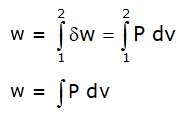
δ W = F×dx
δ W = P Adx
δ W = P dv

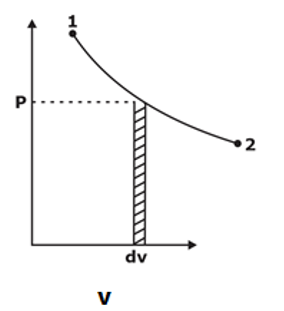
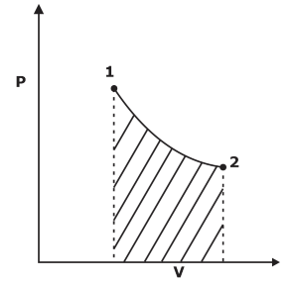
It we draw a graph between pressure and volume and consider a small part of this graph, the area of small element on volume axis is

PATH FUNCTION- Path function are inexact differential, so we use δϕ. Work and heat both are path function.  

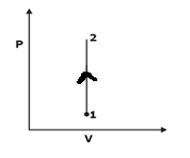
REVERSIBLE CONSTANT VOLUME OR ISOCHORIC PROCESS-  

W = 0

dQ = mcvΔT

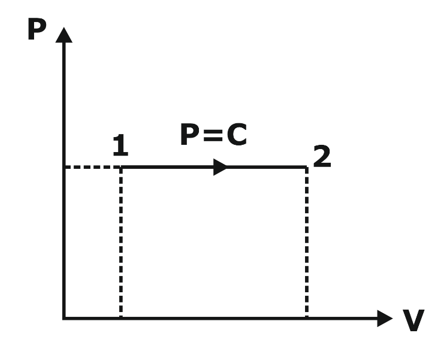
REVERSIBLE CONSTANT PRESSURE OR ISOBARIC PROCESS- 

W = P (V2 – V1)

dQ = mcPΔT

REVERSIBLE ISOTHERMAL PROCESS- 

dQ = dW

REVERSIBLE ADIABATIC PROCESS- 

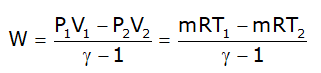
Q = 0


basic concepts of thermodynamics

The word Thermodynamics originates from the Greek words therme (heat) and dynamic (power), so thermodynamics can be referred as the science in which study of the transfer of heat takes place.

“Thermodynamics is the study of energy transfer and its transformation and effects on the physical properties of substance”.

System

A system can be defined as a quantity of matter (control mass) or a region (control volume) in space selected for the study.

SURROUNDING- Everything external to the system is known as surrounding or the environment. Energy interaction is studied between the system and surroundings i.e. every energy leaving the system will be absorbed by the surrounding and vice versa.

BOUNDARY- An imaginary or real surface that demarcates the system from its surroundings is known as the boundary. The boundary is the surface of contact between the system and surrounding, thus, shared by both the system and the surroundings. Mathematically, the boundary has no thickness, and can neither occupy any volume in space nor contain any mass. The boundary may either be moving or fixed.

Universe- A system and its surroundings together constitute the universe. Everything is contained in the universe, so everything occurring whether energy transfer or transformation or losses remains inside the universe.

Types of System

Depending upon the mass and energy interaction.

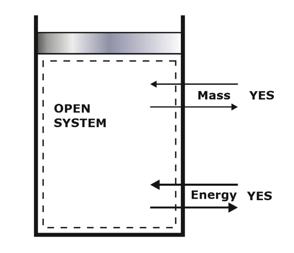
(i) Open System – When there is mass as well as energy transfer across the boundary, that type of system is called an Open system. Example - air compressor, boiler, pump, IC engine with valve open, etc. The majority of engineering devices come under this category.

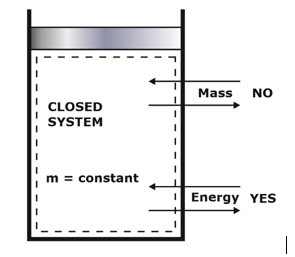
(ii) closed system –When in a system, the mass remains fixed or constant but there may be energy transfer into or out of the system i.e. no mass transfer occurs across the system boundary but only energy transfer. Example –  Tea in kettle, automobile engine with valve closed etc.

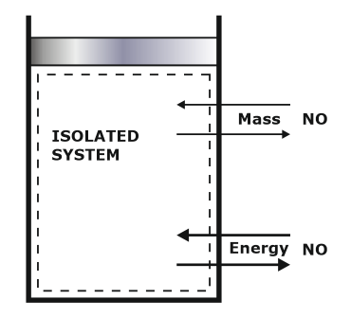
(iii) Isolated system - When there is no mass and energy interaction taking place between the system and the surroundings, such systems are called isolated systems. It is of fixed mass and energy, and there is no mass or energy interaction across the system boundary. Example – thermo-flask, Universe 

Macroscopic v/s Microscopic Approach

Macroscopic Approach - When a certain quantity of matter is considered, without getting into molecular level, such systems are called Isolated systems (also called as classical approach). Every property will be the average of that property of each molecule passing through that space.

Microscopic Approach - When study is made on a molecular level as matter is composed of a large number of molecules, such approach is called a Microscopic approach.  The behavior of the gas is determined by considering the behavior of each molecule.

CONCEPT OF CONTINUUM- The concept of the continuum is the idealization of the continuous description of matter where the properties of the matter are considered as continuous functions of space. The space between the molecules (mean free path) is almost zero or negligible when compared to the size of the system.

Extensive Properties v/s Intensive Properties

(i) Extensive Properties – The properties dependent on mass are known as extensive properties (sometimes known as extrinsic properties). Since, the mass of the specimen changes, the value of extensive properties will also change according to it.
Example – Volume, Enthalpy, Weight, etc. 

(ii) Intensive Properties – Extrinsic properties per unit mass, are intensive properties. These properties are independent of the mass of the system (also known as intrinsic properties). It is a system property, independent of quantity. 
Example – Pressure, Density, Viscosity, specific energy, specific enthalpy etc.

Thermodynamic Equilibrium

When no change in macroscopic properties is observed, a system is said to be in a state of thermodynamic equilibrium. A system will be in a state of thermodynamic equilibrium if the following conditions are met:

(i) Mechanical Equilibrium - without the presence of an unbalanced force within the system itself and also between the system and the surroundings.

(ii) Chemical equilibrium - an absence of any chemical reaction or transfer of matter from one part of the system to another.

(iii) Thermal equilibrium - When a system exists in mechanical as well as a chemical equilibrium when separated from its surroundings by a diathermic wall (diathermic means ‘which allows heat to flow’).

Even when one of these conditions is not met, the system can't be in thermodynamic equilibrium.

The thermodynamic properties are defined only for thermodynamic equilibrium states.

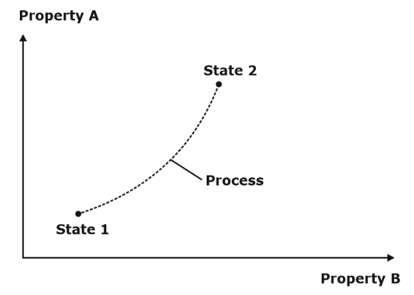
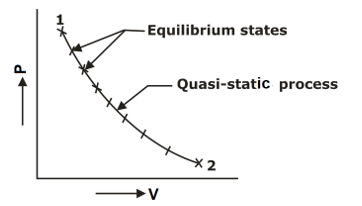
PROCESS - Any change of state that a system undergoes, from one equilibrium state to another equilibrium state is known as a process.

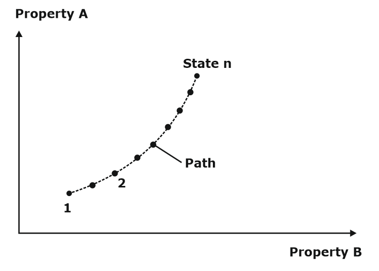
PATH - The succession of states passed through during a change of state from an initial condition to the final required condition, is called the path of the change of state.


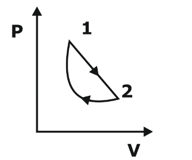
CYCLE -  A series of changes in states of a system, such that the final point of the system coincides with the initial point is termed as a cycle.

QUASI-STATIC PROCESS-  The meaning of ‘Quasi’ is ‘almost’ and the meaning of ‘Static’ is ‘at rest’.  The characteristic feature of a quasi-static process is its infinite slowness. A process that is the locus of all the equilibrium states the system passes through from an initial condition to the final desired condition is known as a quasi-static process. Every state of the system through which it passes during this process is an equilibrium state.

Reversible and Irreversible Process

A reversible process is a process that can be reversed without causing any permanent change in the surroundings. That is, both the system and the surroundings are returned to their initial states if the given process is reversed. In the property diagrams, reversible processes are shown by continuous line or curve whereas irreversible processes are shown by dotted line or curve.

Reversible processes are actually only theoretical. They are a mere idealization of actual processes. Processes that are not reversible are termed irreversible processes.

PURE SUBSTANCE- A  substance that has a uniform and invariable chemical composition throughout its mass is known as a pure substance.

Examples: Atmospheric air, steam-water mixture, ammonia, etc.

IDEAL GAS EQUATION - Ideal (perfect) gas equation is a unique equation of state, which is applicable specifically to ideal gases. The molecular forces of attraction between gas molecules are negligible in an ideal gas. The volume of the molecules should be negligible compared to the total volume for a perfect gas. Following is the perfect or ideal gas equation :

PV=nRT

Where:
P = Absolute Pressure = atmospheric pressure + Gauge pressure (in pascal)
V = Volume in m3
R= Universal Gas constant = 8.314KJ/Kmol-K
T = Absolute temperature in kelvin
n = number of moles (in k-mol)

Boyle’s Law-  When the temperature is kept constant, the variation of pressure is such that for a volume of a given mass of gas it varies inversely.

Charles Law- When the pressure remains constant, then the volume occupied by a fixed amount of gas is directly proportional to its absolute temperature. 


What is smartfactory

Smart factories have emerged as the future of manufacturing, revolutionizing industrial processes through advanced technologies and automati...